The story behind the game
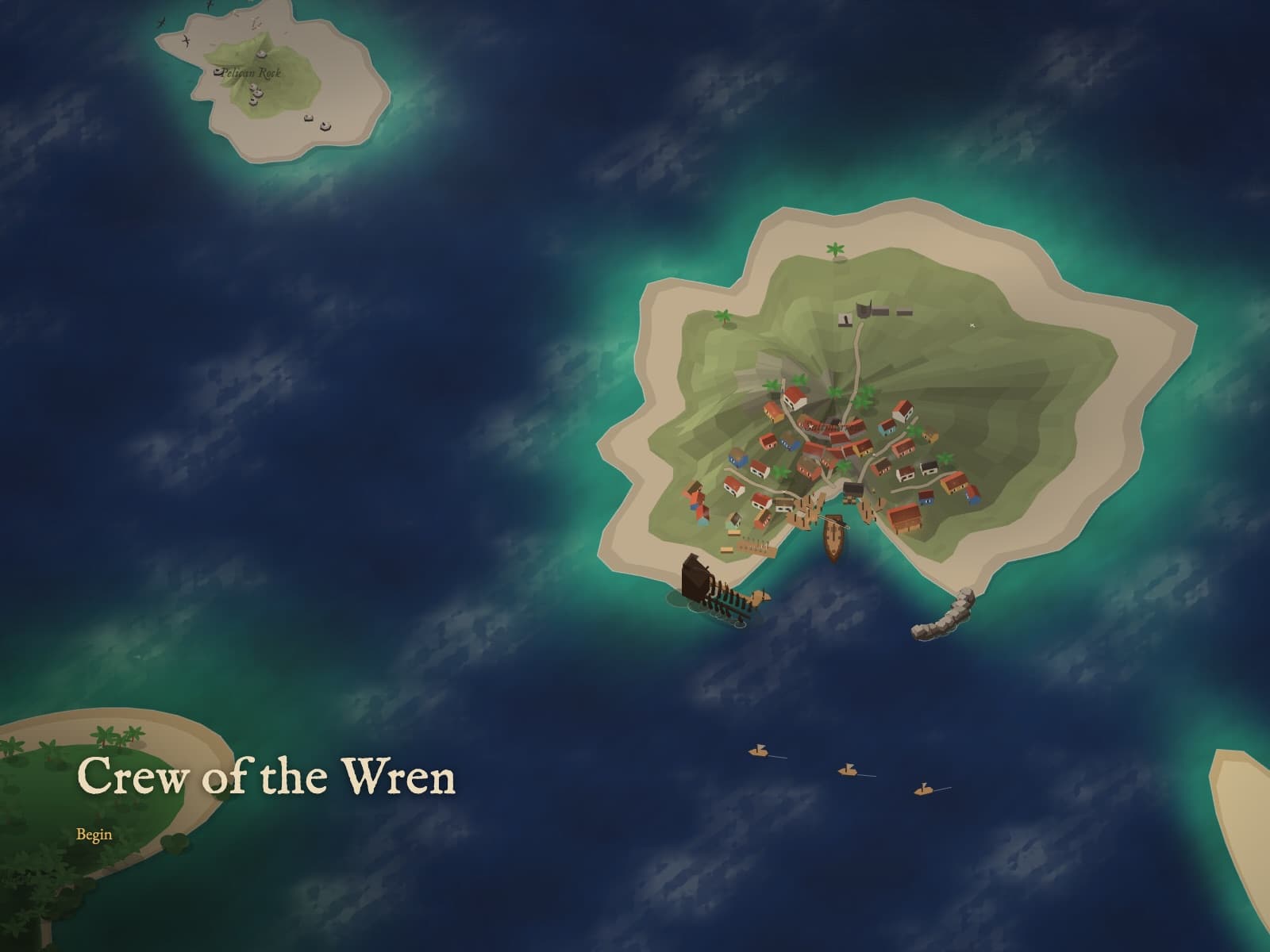
Crew of the Wren
A pirate game built around one question: will these people follow me?
The short version
- The game
- A pirate game for the browser where your crew are people, with moods, memories, and opinions of you.
- My part
- I set the vision and the rules, approved every feature, and decided what shipped. An AI coding assistant wrote the code under my direction.
- So far
- 62 releases and 59 logged decisions since October 3, 2026, and it's playable today.
- My role
- Creator and project lead
- Timeline
- Since October 3, 2026
- Who wrote the code
- An AI coding assistant (Claude Code), working under my direction
- Made with
- JavaScript, HTML Canvas, Three.js, Git and GitHub
- Status
- Playable, and still growing
What it is
Most pirate games ask whether you can win the fight. I wanted one that asks whether your crew will follow you into it. You're the captain, and your crew are people with personalities, memories, friendships, grudges, and opinions of you. You give the orders, and they carry them out with their own judgment.
On day one I set a north star: “stories, not statistics.” I want you to remember the storm where one shipmate grabbed another at the rail even though they hated each other, not that crew morale was 74.
The little things
I'm a huge fan of the small details, the stuff you might not even notice at first. As you sail, you may notice schools of fish in the shallows that scatter when your ship gets too close, or flocks of birds circling overhead and resting on the rocks. If you're lucky, dolphins will come ride along at your bow, and out in deep water you might even spot a whale.
Same goes for the atmosphere. Cloud shadows drifting over the water and little wisps that show which way the wind is blowing were both my own requests, and at night the ships' lanterns glow in the dark. None of it wins you anything. It's just there to make the sea feel real, and honestly it's some of the stuff I love most about the game.
What I did
I was the creator and project lead. I set the vision and the rules, said yes or no to every feature, played each release, and decided what shipped. An AI coding assistant wrote the code under those rules, and it also kept the project's documentation up to date.
How I kept it on track
A plan, and a list of things I wouldn't do
Before building features, I wrote a vision document: what the game is about, what it isn't (it isn't mainly a combat game or an economy simulator), and a list of things I'm putting off on purpose, like trading, romance, and sound. When a new idea came along, I held it up against that list.
Nothing gets built without my yes
My rule was simple: new features and design changes need my approval first, while bug fixes can just get fixed. Playtest feedback turned into proposals, and I said yes or no. It kept the project mine without slowing down the small stuff.
A diary of decisions
Every significant decision got a date, a reason, and a name. When I changed my mind, that went in too, so the log shows how my thinking moved and not just where it landed.
One thing at a time
The roadmap goes Feel, then Life, then Atmosphere, then Depth. My rule was to make the game feel good before making it bigger.
A way back
Everything ships as a small tagged release, so any earlier version can be recovered. The history also lives on GitHub, not just on my computer, and I never rewrite it without asking.
Checks that run themselves
More than 25 automated test files cover things like the crew, combat, weather, and saving, including one that runs the game for a long stretch to catch slow problems. I also kept a playtest checklist and wrote two audits, one on the engineering and one on how the game looks and feels.
Times I changed my mind
A decision log is only worth keeping if it shows the plan changing. Here are a few moments from the first three weeks.
- Oct 7
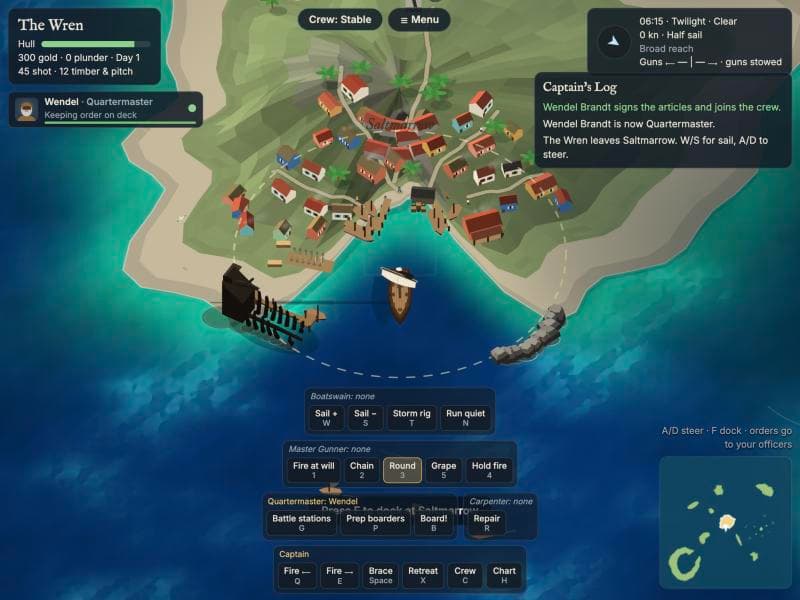
Dropped the 3D view
The 3D version looked unfinished and was harder to read than a 2D one. I switched to 2D and kept the animated water, which was the part worth keeping.
- Oct 11
Folded two features into one
Grapnels needed the same range and speed as boarding, so a separate command was just clutter. They became one.
- Oct 11
Undid an idea the same day
I tried a ring around the ship to show which way the wind was blowing. I didn't like it, so by the end of the day it was replaced with soft wisps drifting over the sea.
- Oct 17
Cleaned up before adding more
Before adding any more features, I ran an engineering audit. It led to splitting a 2,915-line drawing file into seven smaller ones, and every step was checked to look pixel-for-pixel identical before I moved on.
- Oct 22
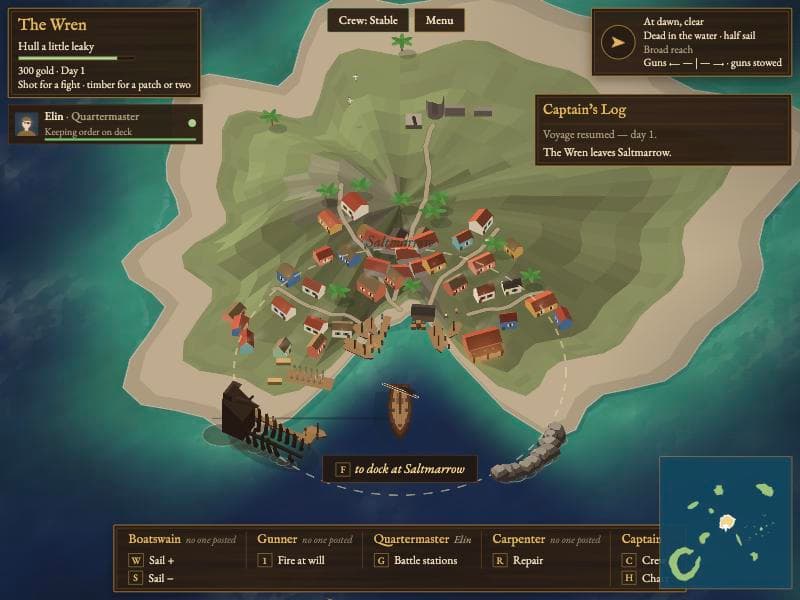
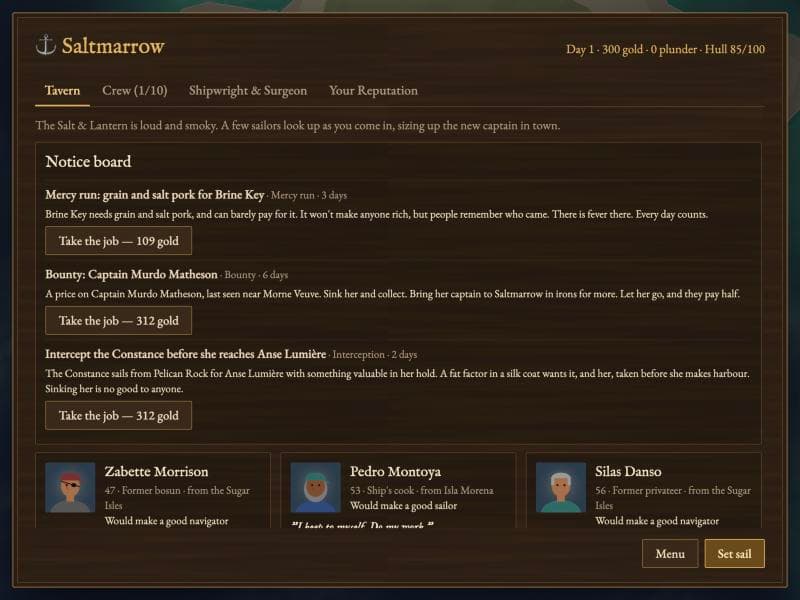
Admitted the menus looked generic
A look-and-feel audit found that the world looked hand-made but the interface looked like any web app. I rebuilt it in four steps around one idea: the inside of a ship's cabin, all dark wood and brass, where orders only show up when they matter.
By the numbers
- 62
- small releases
- 59
- decisions written down
- 25+
- automated test files
- 17,000+
- lines of code
What's next
Next up is a big call: whether to move to real 3D ship models. It's written up as a proposal, and it's waiting on me. After that comes the game's second region, Whalehaven, a fjord coast full of ice and snow squalls, with its layout already decided.
Play the game